

Credit card debt can feel suffocating. Every month, you pay your bill, but the balance barely budges. Why? Because interest compounds relentlessly, devouring your income before you even have a chance to make real progress. If you’re carrying balances on high-interest credit cards, watching the interest charges pile up can be demoralizing and financially draining.
But there’s hope. A balance transfer might be the debt-relief solution you’ve been looking for.
In 2026, the best balance transfer credit cards offer something remarkable: 0% APR (Annual Percentage Rate) for up to 21 months. Imagine moving your $5,000 debt from a card charging 25% APR directly to a card charging 0% interest. That’s not just a minor improvement—that’s a life-changing financial breakthrough.
During that interest-free grace period, every dollar you pay goes toward eliminating the actual debt, not feeding the interest machine. You can pause the interest entirely and dedicate months—nearly two years—to aggressively paying down what you owe. For Americans drowning in credit card debt, balance transfer cards represent one of the most powerful debt-elimination tools available today.
What is a Balance Transfer Credit Card?
A balance transfer credit card is a credit card designed specifically to help you consolidate high-interest debt. Here’s how it works in simple terms: You move your existing credit card balance from a card with a high interest rate to a new card offering a 0% introductory APR. For a set promotional period—typically 12 to 21 months—you owe no interest on that transferred balance.
How It Works: A Real-World Example
Let’s say you’re carrying $5,000 on a credit card charging 25% APR. Without making major changes, here’s what happens:
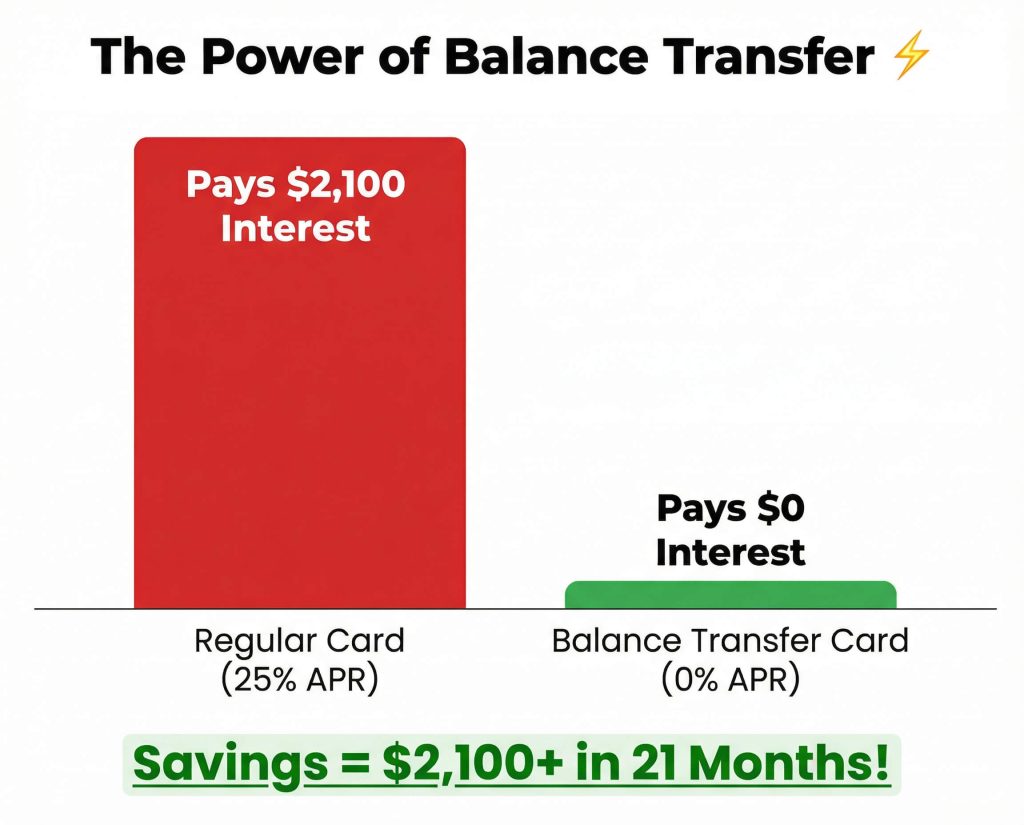
On Your Current High-Interest Card: – Monthly interest rate: 2.08% (25% ÷ 12 months) – If you pay $100/month, about $104 goes to interest; only $71 reduces your balance – Timeline to pay off: Over 6 years – Total interest paid: Roughly $2,100+
On a Balance Transfer Card with 0% APR for 21 Months: – Monthly interest rate: 0% – If you pay $238/month, the entire $238 reduces your balance (plus the transfer fee) – Timeline to pay off: 21 months – Total interest paid: $0 (except for the one-time balance transfer fee, usually 3-5%)
Your Savings: Approximately $2,100 in interest—or more.
Even after accounting for the balance transfer fee (typically $150-$250 on a $5,000 balance), you’re still saving thousands of dollars. That’s the power of eliminating interest charges entirely.
Top 5 Best Balance Transfer Cards for 2026
Here are the five best balance transfer credit cards available to American consumers in 2026. Each offers distinct advantages depending on your financial situation and debt-payoff timeline.
1. Citi Diamond Preferred Card
Best For: Borrowers who want the longest balance transfer interest-free period available, with no annual fee and no rewards needed.
| Feature | Details |
| Intro APR on Balance Transfers | 0% for 21 months |
| Balance Transfer Fee | 5% ($5 minimum) |
| Intro APR on Purchases | 0% for 12 months |
| Regular APR | 16.49% – 27.24% (Variable) |
| Annual Fee | $0 |
| Transfer Deadline | 4 months from account opening |
Why Choose It: The Citi Diamond Preferred offers one of the longest balance transfer interest-free periods on the market. If you have a moderate amount of debt and want nearly two full years to pay it off without interest accruing, this card gives you maximum breathing room. The lack of an annual fee means you can keep this card open long-term without paying a yearly maintenance cost. The 0% APR on new purchases for 12 months is also valuable if you have unexpected large expenses during your payoff period.
2. Wells Fargo Reflect Card
Best For: People seeking a balance transfer card that also offers 0% APR on new purchases, providing flexibility for both existing debt and planned expenses.
| Feature | Details |
| Intro APR on Balance Transfers | 0% for 21 months |
| Balance Transfer Fee | 5% ($5 minimum) |
| Intro APR on Purchases | 0% for 21 months |
| Regular APR | 17.49%, 23.99%, or 28.24% (Variable) |
| Annual Fee | $0 |
| Transfer Deadline | 120 days from account opening |
Why Choose It: The Wells Fargo Reflect stands out because it extends its 0% APR offer to both balance transfers and new purchases for the full 21 months. This dual benefit is rare. If you’re planning major expenses—home repairs, medical bills, travel—during your debt-payoff period, you won’t need to put them on a separate card charging interest. The card also provides cellular telephone protection (up to $600) and roadside dispatch assistance, adding practical value beyond the core balance transfer offer.
3. Citi Simplicity Card
Best For: Cardholders prioritizing the lowest balance transfer fees and who value the protection of no late fees or penalty APR.
| Feature | Details |
| Intro APR on Balance Transfers | 0% for 21 months |
| Balance Transfer Fee | 3% ($5 minimum) for first 4 months; 5% ($5 minimum) after |
| Intro APR on Purchases | 0% for 12 months |
| Regular APR | 17.49% – 28.24% (Variable) |
| Annual Fee | $0 |
| Special Features | No late fees; no penalty APR |
| Transfer Deadline | 4 months from account opening |
Why Choose It: The Citi Simplicity Card offers the lowest introductory balance transfer fee available: just 3% if you transfer within the first four months. On a $10,000 balance, that’s $300 instead of $500—a meaningful difference. Even more valuable is the “no late fees” guarantee: if you miss a payment, Citi won’t charge a late fee. This zero-penalty approach provides psychological relief and protects you if life throws an unexpected curve ball. While the regular APR can climb to 28.24%, the long 21-month grace period gives you ample time to eliminate your balance before any interest kicks in.
4. Discover it Balance Transfer
Best For: Borrowers who want cash back rewards on everyday purchases while paying off transferred debt, plus lower fees during the promotional period.
| Feature | Details |
| Intro APR on Balance Transfers | 0% for 15 months |
| Balance Transfer Fee | 3% (intro) until April 10, 2026; then 5% |
| Intro APR on Purchases | 0% for 15 months |
| Regular APR | 17.49% to 26.49% (Variable) |
| Annual Fee | $0 |
| Rewards | Unlimited 1% cash back on all purchases; 2% cash back on gas and restaurants (up to $1,000/quarter, then 1%) |
| Special Offer | Discover matches all cash back earned in your first year (Cashback Match) |
Why Choose It: While the Discover it Balance Transfer offers a shorter interest-free period (15 months vs. 21), it compensates by offering cash back rewards—something most balance transfer cards exclude entirely. That unlimited 1% cash back means you’re earning money back on everyday purchases while paying down debt. The promotional 3% balance transfer fee (through April 2026) is also competitive. Plus, Discover’s Cashback Match feature automatically doubles your cash back rewards from the first year, making your earning potential even stronger. This card works best if you plan to use it for ongoing purchases, not just the balance transfer.
5. Chase Slate Edge
Best For: Borrowers who want an 18-month interest-free period with flat 3% balance transfer fees, plus the potential for automatic APR reductions based on good payment behavior.
| Feature | Details |
| Intro APR on Balance Transfers | 0% for 18 months |
| Balance Transfer Fee | 3% (flat—no reduced-fee window) |
| Intro APR on Purchases | 0% for 18 months |
| Regular APR | 18.24% – 28.24% (Variable) |
| Annual Fee | $0 |
| Special Feature | Automatic 2% APR reduction consideration annually when you spend $1,000+ and pay on time |
Why Choose It: The Chase Slate Edge is the newest generation balance transfer card from Chase and includes a unique feature: automatic APR reduction potential. If you spend at least $1,000 during your account anniversary and make all payments on time, Chase will automatically consider you for a 2% APR reduction (down to a floor of Prime Rate + 9.74%, currently around 16.49%). While the interest-free period is slightly shorter at 18 months, the 3% flat balance transfer fee is locked in and applies immediately—no waiting for a promotional window to expire. This consistency is valuable for planning.
Comparison Table: Top Balance Transfer Cards at a Glance
| Card | Intro APR(BT) | BT Fee | Intro APR (Purchases) | Annual Fee | Best For |
| Citi Diamond Preferred | 0% / 21 mo | 5% | 0% / 12 mo | $0 | Longest BT period, no-frills |
| Wells Fargo Reflect | 0% / 21 mo | 5% | 0% / 21 mo | $0 | Longest period on both BT & purchases |
| Citi Simplicity | 0% / 21 mo | 3% (1st 4 mo) | 0% / 12 mo | $0 | Lowest BT fee, no late fees |
| Discover it BT | 0% / 15 mo | 3% (through Apr 2026) | 0% / 15 mo | $0 | Cash back rewards earner |
| Chase Slate Edge | 0% / 18 mo | 3% | 0% / 18 mo | $0 | APR reduction potential |
Step-by-Step Guide: How to Do a Balance Transfer
Performing a balance transfer is straightforward, but following these steps carefully ensures you capture the full promotional benefit and avoid costly mistakes.
Step 1: Choose Your Balance Transfer Card
Research and select the card that best matches your debt amount, timeline, and financial goals. Consider: – How much debt you’re transferring – How quickly you can pay it down – Whether you want the longest interest-free period or lowest fees – If you value cash back or other perks
Step 2: Apply for the New Card
Visit the card issuer’s website or apply online. Complete the application with your financial information (income, employment, etc.). You’ll typically receive approval or denial within minutes to hours. If approved, the issuer will notify you of your credit limit.
Important: Confirm the balance transfer offer is included before finalizing your application. Some cards allow you to request a balance transfer at the point of application, which can speed up the entire process.
Step 3: Wait for Your Card to Arrive
Most new credit cards take 5-10 business days to arrive at your address. Some issuers (like Chase) offer instant digital card access through your mobile wallet, allowing you to use the card immediately for purchases. However, you typically must wait for the physical card or use the card issuer’s online portal to request the balance transfer.
Note: Some issuers require your account to be open for a minimum period (e.g., 14 days for Discover new accounts) before processing a balance transfer request.
Step 4: Request Your Balance Transfer
Once you have access to your account (online or the physical card has arrived), initiate the balance transfer request. You can typically do this by: – Logging into your online account and selecting “Request Balance Transfer” – Calling the card issuer’s customer service number on the back of your new card – Submitting a balance transfer request at a bank branch (for cards issued by banks with physical locations)
You’ll need to provide: – The account number of the card you’re transferring from – The creditor name or card issuer – The amount you want to transfer
Step 5: Pay the Balance Transfer Fee
The balance transfer fee is automatically added to your new card’s balance. For example, if you transfer $10,000 at a 3% fee, your new balance becomes $10,300. This fee is part of your total payoff amount and will accrue no interest during the promotional period (unlike your actual balance, which now has 0% APR).
Step 6: Wait for the Transfer to Complete
Processing times vary by issuer: – Chase: 7 to 21 days – Citi: 2 to 21 days – Discover: 4 days for existing accounts; new accounts must wait 14 days before transfer begins – Wells Fargo: Up to 14 days
During this waiting period, continue making payments on your old card to avoid late fees or credit score damage. Once the transfer completes, your old card’s balance will be zero.
Step 7: Create a Repayment Plan
Calculate how much you need to pay monthly to eliminate your balance before the promotional period expires.
Simple Formula: (Total Transferred Balance + Fee) ÷ Number of Months = Monthly Payment
Example: $10,300 balance ÷ 21 months = $490.48/month to pay off in time
Set up automatic payments to your new card to ensure you never miss a deadline. Missing the promotional period deadline is one of the costliest mistakes you can make.
The “Hidden” Costs & Mistakes to Avoid
Balance transfer cards are powerful debt-elimination tools, but they come with hidden pitfalls. Avoid these common mistakes to maximize your savings.
1. Overlooking the Balance Transfer Fee
The balance transfer fee (typically 3-5%) is not optional—it’s automatically added to your transferred balance. Many people calculate their savings based solely on avoided interest, forgetting this upfront cost.
Example of the Impact: – Transfer: $5,000 – Fee at 3%: $150 – Fee at 5%: $250 – Your new balance: $5,150 or $5,250
Yes, paying 3% as a one-time fee is far better than paying 25% annually in interest. But don’t be shocked when you see the higher balance on your first statement. This fee is paid off interest-free along with your original balance.
2. Making New Purchases on the Card
This is a critical mistake. Once you’ve transferred a balance, your new card typically charges the regular APR (usually 18-28%) on any new purchases you make. This isn’t covered by the 0% promotional period.
Why It’s Dangerous: If you transfer $5,000 and then charge $500 in new purchases, you’re now paying regular interest on that $500 in new charges, while the $5,000 enjoys 0% APR. You’re essentially reversing your debt-relief strategy.
Best Practice: Treat your balance transfer card as a “debt-payoff card only.” Don’t use it for new purchases. If you need to make purchases during your payoff period, use a different card or pay with cash.
3. Missing the Balance Transfer Deadline
Most cards require you to complete balance transfers within a specific window—usually 60 to 120 days from account opening. Once this deadline passes, any new balance transfers you make will be charged the regular, higher APR, not the 0% promotional rate.
Example: – Card approval: January 10, 2026 – Transfer deadline: April 10, 2026 (90 days) – If you transfer on April 11: Your balance charges regular APR, not 0%
Solution: Mark your calendar immediately. Set phone reminders. Don’t rely on memory alone. The cost of missing this deadline is too high.
4. Not Planning for the End of the Promotional Period
Your 0% APR won’t last forever. After 21 months (or whatever your card’s term is), the regular APR kicks in. If you haven’t paid off the balance by then, you’ll suddenly owe significant interest on any remaining balance.
What Happens: – Promotional period ends: Month 22 – Remaining balance: $2,000 – New APR: 25% – Sudden monthly interest charge: ~$41.67
Solution: Create a realistic repayment plan before you transfer. Calculate your required monthly payment and commit to it. If you can’t afford to pay off the balance during the promotional period, a balance transfer might not be the right move—or you may need to transfer a smaller amount.
5. Assuming You Can Transfer All Your Debt
Credit limits vary. You may be approved for a $5,000 limit but have $12,000 in debt. You can’t transfer more than your approved credit limit, and your balance transfer limit may be even lower.
Solution: Before applying, estimate how much you need to transfer. If you have excellent credit, you can call the card issuer after approval and request a higher credit limit. However, this requires another hard inquiry on your credit report.
6. Continuing to Use Your Old Cards
After successfully transferring a balance, your old card’s available credit resets to your full limit. Don’t use it. This is how people fall into a debt spiral: they transfer $5,000, then charge $3,000 more on the old card, and suddenly they’re back where they started—or worse.
Solution: Once you’ve transferred a balance, either: – Cut up the old card(s) or freeze them (literally or digitally) – Keep them in a safe place, never to be used – Call the card issuer and request a lower credit limit to reduce temptation
Best Balance Transfer Credit Cards 2026 (0% APR for 21 Months)
Q1: Does a balance transfer hurt my credit score?
Yes, but usually only temporarily, and the long-term benefit outweighs the short-term impact.
Here’s What Happens:
Negative Impact (Short-Term):
Hard Inquiry: When you apply for the new card, the issuer checks your credit report (a “hard inquiry”). This can lower your credit score by 5-10 points temporarily. However, the impact diminishes after a few months and disappears after 12 months.
New Account: Opening a new credit card lowers your average account age, which can reduce your score by a few points.
Increased Utilization (Initially): If your new card has a lower credit limit than your existing card, your utilization ratio might initially increase. However, this typically reverses as you pay down the balance.
Positive Impact (Long-Term):
– Lower Utilization Ratio: If you’re consolidating multiple high-balance cards into one, your overall utilization ratio improves. For example, if you had $8,000 spread across three cards with a combined limit of $15,000 (53% utilization) and transfer to a card with a $12,000 limit, your new utilization is 67% on that card but 0% on the old cards. Your overall utilization can improve significantly.
– Faster Debt Payoff: The 0% APR allows you to pay down debt faster, which improves your credit score over time.
– Reduced Risk of Late Payments: Consolidating multiple payments into one reduces the chance of missing a payment, protecting your score.
Bottom Line: Balance transfers typically cause a small, temporary credit score dip (10-20 points) that recovers within a few months. The long-term benefit of reduced debt and faster payoff far outweighs this temporary impact.
Q2: How long does a balance transfer take?
5 to 21 days, depending on the card issuer. Most complete within 7-14 days.
Timeline by Issuer: – Chase: 7 to 21 days – Citi: 2 to 21 days – Discover: 4 days for existing cardholders; new cardholders must wait 14 days before the transfer begins, then add 4 days – Wells Fargo: Up to 14 days – American Express: 5 to 7 days (but up to 6 weeks in rare cases)
Important: During the waiting period, your balance transfer request is pending. Your old card still has the outstanding balance. You must continue making at least minimum payments on your old card to avoid late fees and credit damage. Once the transfer completes (the issuer of your old card receives payment from the new card issuer), your old balance will drop to zero.
Pro Tip: Some cards allow you to request a balance transfer at the point of application, which can slightly speed up the process since the issuer can begin processing immediately upon approval.
Q3: Can I transfer a balance between cards from the same bank?
No, in almost all cases. You cannot transfer a balance from one card to another card if both are issued by the same bank.
Why Not?
Banks make money primarily through interest and annual fees. If you transfer a balance between two of their own cards, the bank loses interest revenue while still owing you the cost of acquiring a new customer. This makes no financial sense for the bank. As a result, virtually all banks prohibit same-issuer balance transfers.
Examples of What’s NOT Allowed: – Transferring from a Bank of America card to another Bank of America card – Transferring from a Chase card to another Chase card – Transferring from a Citi card to another Citi card – Transferring from a Wells Fargo card to another Wells Fargo card
What IS Allowed: You can transfer from any card to a card issued by a different bank. For example: – Chase to Citi ✓ – Bank of America to Wells Fargo ✓ – Capital One to Discover ✓ – American Express to Citi ✓
Business Cards Exception: The same rule applies to business credit cards. You cannot transfer between two business cards from the same issuer, but you can transfer a business card balance to a business card at a different bank.
If You Need a Workaround: Some people have attempted to transfer from Bank A to Bank B, then transfer from Bank B back to Bank A (same issuer). Don’t do this. You’ll pay double balance transfer fees and trigger multiple hard inquiries on your credit report, damaging your score more than the original transfer would.
Conclusion
High-interest credit card debt doesn’t have to control your financial future. In 2026, balance transfer credit cards offer an unprecedented opportunity to pause interest entirely for up to 21 months—giving you a realistic window to eliminate debt without the burden of compounding interest.
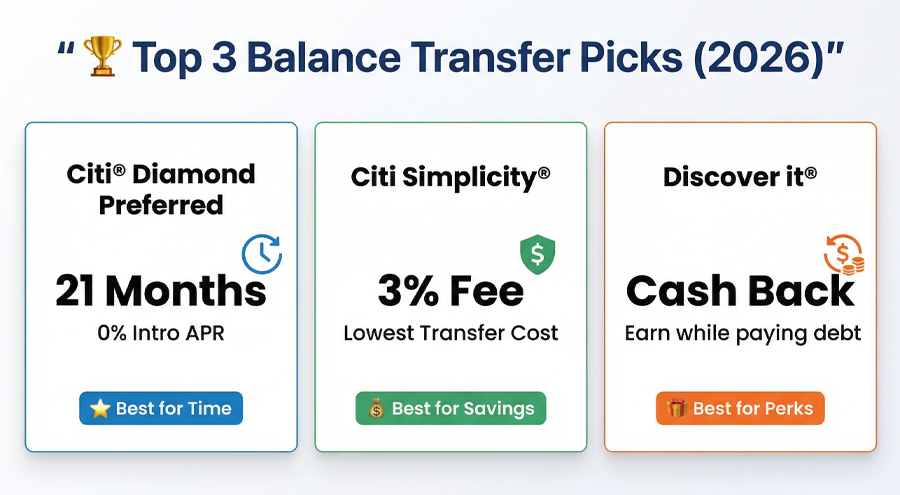
The Citi Diamond Preferred and Wells Fargo Reflect both offer the longest interest-free periods (21 months), while the Citi Simplicity provides the lowest balance transfer fees (3% for early transfers). The Discover it Balance Transfer rewards your payoff effort with cash back, and the Chase Slate Edge offers the potential for ongoing APR reductions based on good behavior.
Still struggling with student debt? Read our guide on How to Refinance Student Loans in 2026
Your next steps:
1. Calculate your total debt. Know exactly how much you need to transfer.
2. Choose your card. Match your debt amount and payoff timeline to the card that fits best.
3. Apply immediately. Balance transfer offers can change; don’t delay.
4. Create a repayment plan. Divide your total balance by the number of promotional months. Set up automatic payments.
5. Avoid new charges. Don’t use the card for new purchases.
6. Mark your calendar. Never miss the promotional deadline.
Balance transfer cards are not a magic cure for overspending, but they are a legitimate, powerful tool for people committed to eliminating existing debt. If you’re ready to stop paying interest and start making real progress, now is the time to apply. The next 21 months could change your financial trajectory forever.